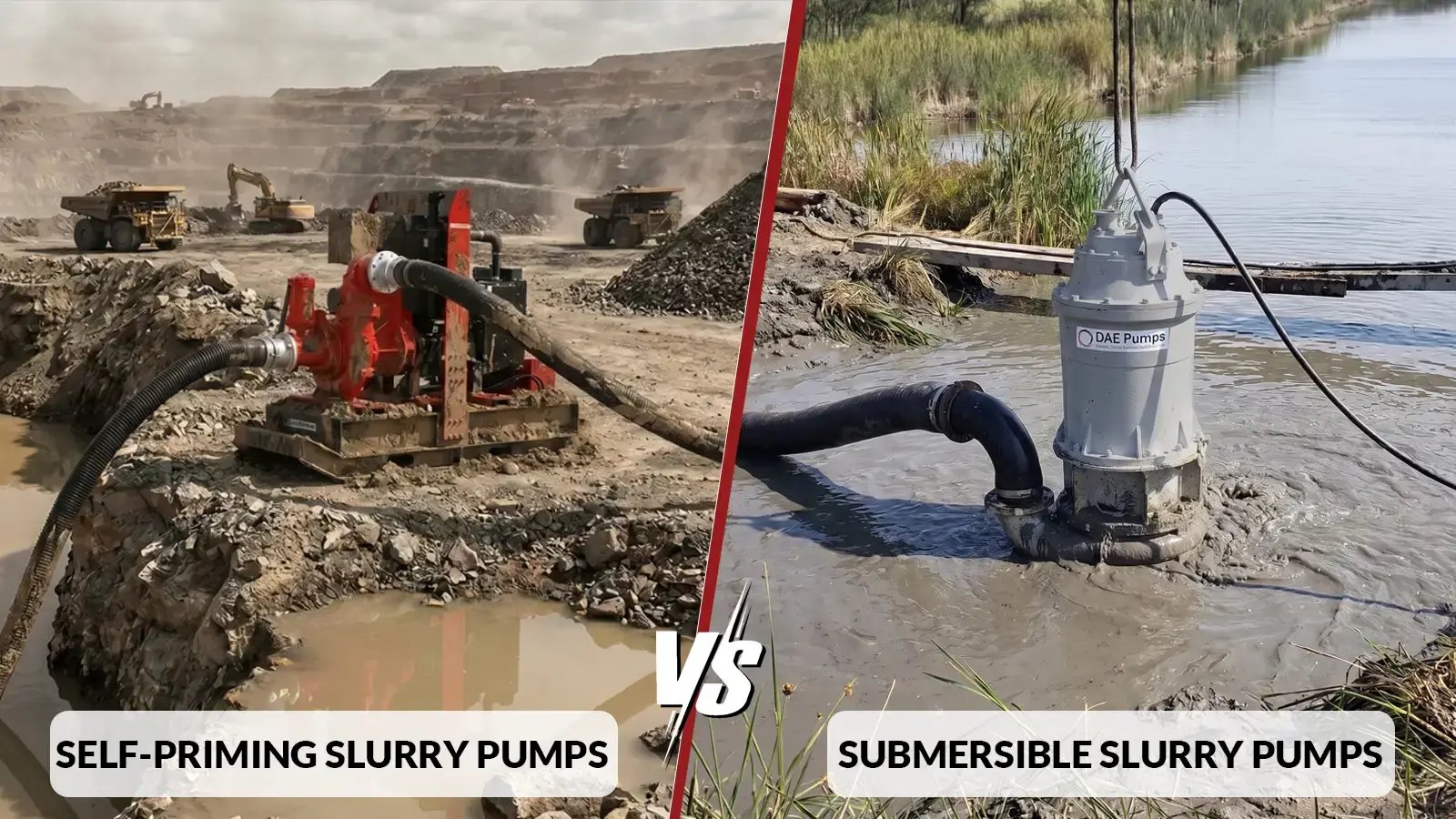
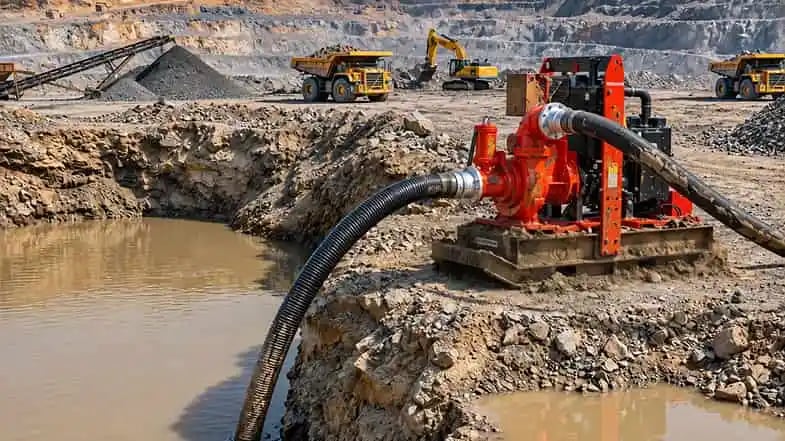
A self-priming pump and a submersible slurry pump can both move water, sludge, slurry, sand, and solids. The difference is where the pump sits and how it gets material into the pump. Self-priming pumps sit above the liquid and pull material up through a suction hose. Submersible slurry pumps sit directly in the liquid, so the pump is already flooded before it starts.

That placement difference affects almost everything: priming time, suction lift, NPSH risk, maintenance access, noise, portability, and whether the pump is better for temporary field work or a fixed sump, pit, lagoon, or dredging location. This guide explains the difference in plain language, shows where each configuration fits, and helps project managers, operators, and procurement teams decide which DAE Pumps path to review before requesting a quote.
Quick Answer
Choose a self-priming pump when the pump needs to stay above the liquid, crews need easy maintenance access, the job moves between locations, or the water level changes but remains within the pump’s suction-lift limits. Self-priming pumps are common for bypass pumping, construction dewatering, surface pumping, temporary transfer, and portable trailer or skid-mounted setups.
Choose a submersible slurry pump when the pump can sit in the sump, pit, pond, basin, or dredging area and the job benefits from no priming step, no suction lift, a smaller above-ground footprint, and strong solids handling at the working face. Submersible slurry pumps are common for mining sumps, dredging, industrial pits, wastewater sludge, sand, sediment, and abrasive slurry removal.
For some systems, neither is the only answer. A project may use a submersible pump at the solids source, a self-priming pump for bypass or transfer, a flooded suction pump in a fixed plant, or a booster pump when discharge distance creates too much head loss. Final selection should be confirmed against flow, head, slurry properties, suction conditions, site access, and the pump curve.
Key Takeaways
- The core difference is placement: self-priming pumps sit above the liquid; submersible pumps sit in the liquid.
- Self-priming pumps are easier to access for maintenance because the pump stays dry and above grade.
- Submersible pumps avoid suction lift and priming time because the pump is already submerged and flooded.
- Self-priming pumps are often better for temporary, mobile, trailer, bypass, or surface pumping jobs.
- Submersible slurry pumps are often better for pits, sumps, ponds, basins, dredging areas, and abrasive solids at the working face.
- The right choice depends on site layout, water level, solids, suction lift, discharge distance, maintenance access, and power availability.
The Core Difference: Above the Liquid vs. In the Liquid
The easiest way to understand the difference is to picture the pump location.
- A self-priming pump sits above the water, sludge, or slurry. Before it can pump normally, it must remove air from the suction line and pull liquid up into the pump casing. That is why suction lift, priming time, foot valves, air leaks, and NPSH matter so much.
- A submersible pump sits underwater. The liquid surrounds the pump, so the inlet is already flooded. There is no suction hose lifting liquid up to the pump, and there is no above-ground priming cycle before pumping begins.
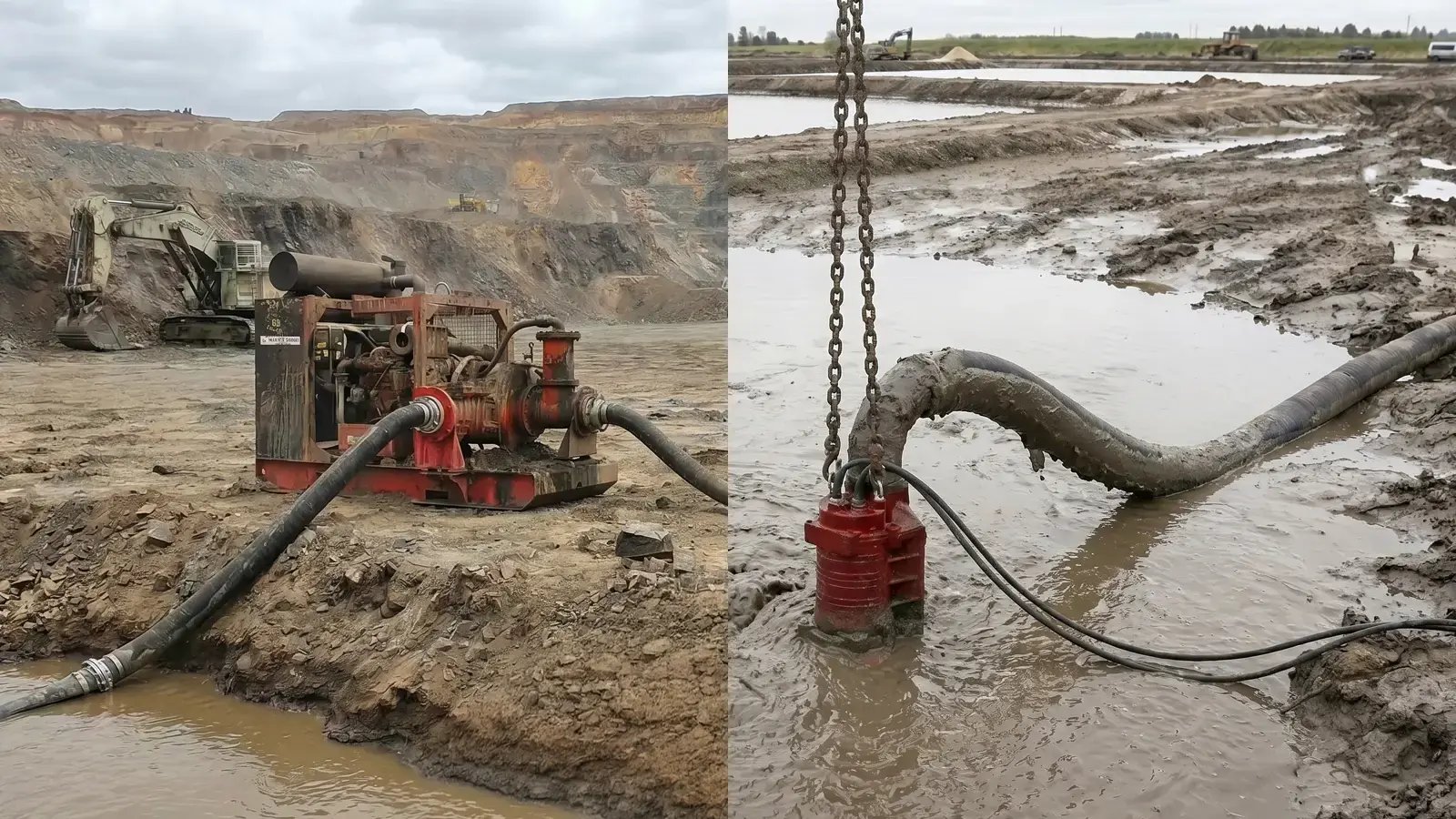
That one difference drives the rest of the comparison. If the job rewards easy access, mobility, and above-water service, self-priming may be the better path. If the job rewards flooded intake, simple deployment into a pit, and pumping solids directly from the source, submersible may be the better path.
Where Self-Priming Pumps Win
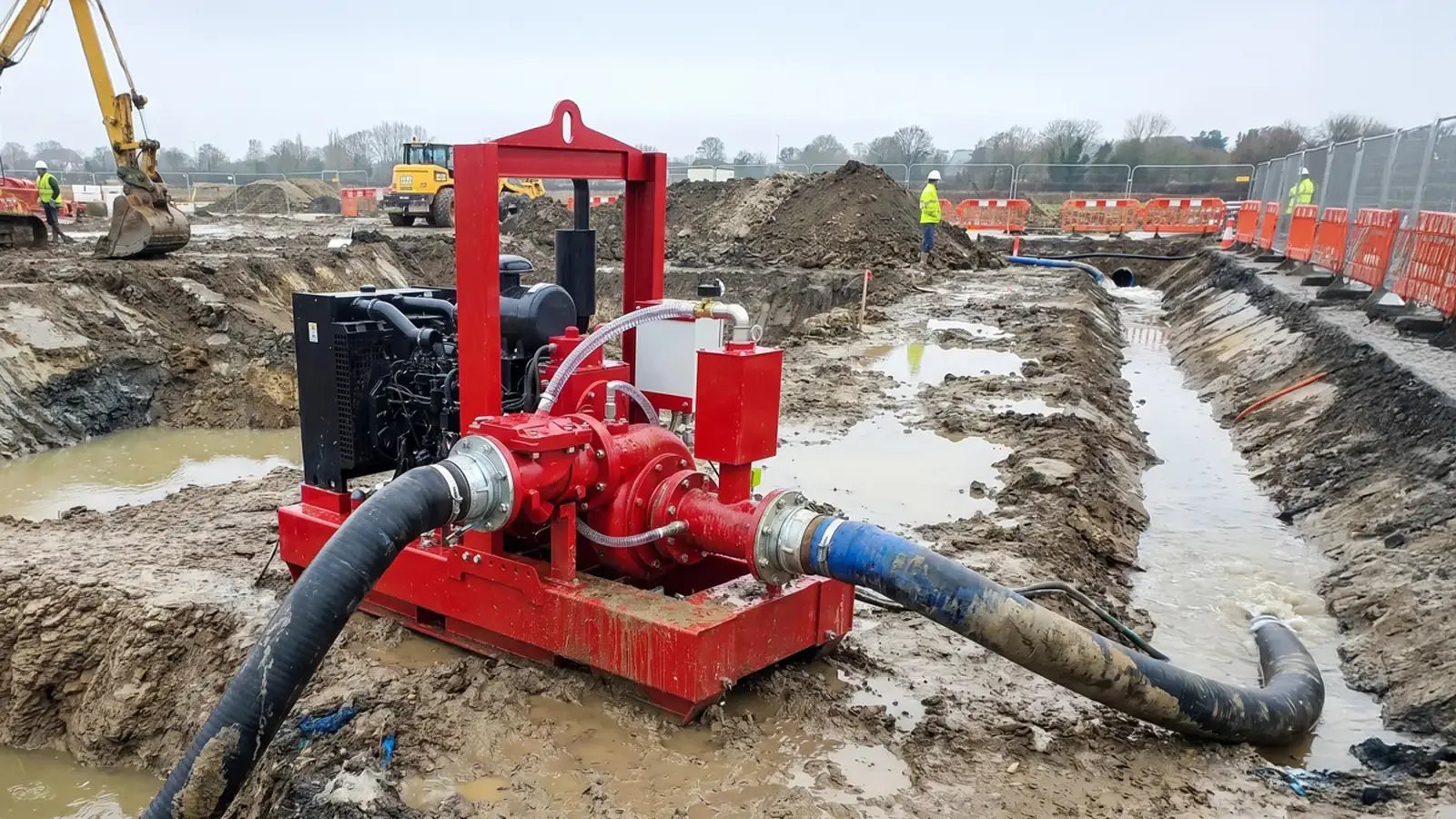
DAE Self-Priming Pumps are useful when the pump needs to stay out of the liquid but still pull liquid and solids from a sump, basin, tank, channel, or work area. For many field jobs, this makes the pump easier to position, service, and move.
Maintenance access
The pump is above the liquid, so crews can inspect seals, bearings, casing, hoses, and fittings without pulling the pump out of the sump or sending personnel into the water. This is valuable when the pump needs frequent inspection or when downtime windows are tight.
Mobility between sites
Self-priming pumps can be mounted on skids or trailers and moved between jobs. DAE MAX-Series self-priming pumps are positioned for portable skid or trailer applications, including electric and diesel options for demanding field work. Review the MAX-Series self-priming pumps when portability, skid mounting, trailer mounting, or diesel power is part of the decision.
Variable water levels
If the water level moves up and down but stays within the pump’s rated suction-lift range, a self-priming pump can remain in place instead of being raised or lowered with the water.
Safer service position
Because the pump stays on land, a platform, or a dry location, routine service can often be performed without lifting wet equipment or opening a wet well.
Where Submersible Slurry Pumps Win
DAE Submersible Slurry Pumps are built for abrasive materials and solids-laden applications where the pump works directly in the fluid. This is often the simpler choice when the pump can be lowered into the sump, pit, pond, or dredging area.
No priming cycle
A submersible pump starts already surrounded by liquid. There is no suction hose full of air to evacuate before pumping begins.
No suction lift limitation
Because the pump sits in the fluid, it does not need to pull liquid upward through a suction line. That removes a major source of NPSH and cavitation problems that can affect surface-mounted pumps.
Strong fit for abrasive solids at the source
For settled sand, sludge, sediment, tailings, and slurry, placing the pump directly in the material can reduce suction-side complications. DAE Tampa Series and Lansing Series submersible slurry pumps are common product paths for abrasive solids and slurry transfer. Review the Tampa Series and Lansing Series when the application involves abrasive slurry, settled solids, or agitator-style intake requirements.
Lower above-ground footprint
Only the power cable, hose or discharge pipe, and lifting/support equipment remain above the liquid. This can help when deck space, plant space, or jobsite footprint is limited.
Lower above-water noise
Because the pump is submerged, the jobsite may see less above-water pump noise than a surface-mounted unit. Actual noise depends on the full system, not just the pump.
Self-Priming vs. Submersible Slurry Pump Decision Table
|
Site condition or requirement |
Better fit |
Why it matters |
|
Pump must be serviced without pulling equipment from the water |
Self-priming |
The pump stays above grade and is easier to inspect and repair. |
|
Pump needs to move between job sites or work areas |
Self-priming |
Skid and trailer-mounted surface pumps are easier to relocate. |
|
Water level fluctuates within suction-lift limits |
Self-priming |
The pump can remain above the source while pulling from the suction hose. |
|
No reliable electric power is available |
Self-priming or diesel package |
Diesel-driven or trailer-mounted self-priming packages may simplify field deployment. |
|
Pump can sit directly in the sump, pit, pond, or basin |
Submersible |
No priming step and no suction lift are required. |
|
Material is settled at the bottom and needs agitation at the intake |
Submersible slurry |
An agitator-equipped submersible pump can help re-suspend solids near the pump. |
|
Deep or fixed wet-well installation |
Submersible |
The pump can operate directly in the liquid with a smaller surface footprint. |
|
Constant gravity feed from a tank or hopper is available |
Flooded suction |
A flooded suction pump may provide easier access than a submersible while staying constantly primed. |
|
Long discharge distance requires pressure support |
Booster-supported system |
A booster pump can help maintain flow and pressure through long pipeline runs. |
Clear Examples by Application
Construction dewatering or bypass pumping
A contractor needs to move between temporary sumps on a jobsite. A self-priming pump on a skid or trailer may be easier to stage, start, inspect, and relocate than a submerged unit. Start with DAE Self-Priming Pumps or the MAX-Series when portability is a key requirement.
Mining sump with abrasive sediment
A mine has a sump collecting water, sand, and settled solids. A submersible slurry pump placed directly in the sump may reduce priming issues and put the pump intake close to the material. Start with DAE Submersible Slurry Pumps for abrasive solids and sump duty.
Wastewater lift or transfer with easy surface access
If the pump can be installed above the wet well and suction conditions are within limits, a self-priming pump may make service easier. If the pump needs to sit in the wet well, a submersible configuration may be better.
Dredging or pond cleanout
A submersible slurry pump or cable-deployed dredge pump may be used directly at the work face, while a self-priming pump may support transfer or dewatering elsewhere on the same project. For dredging-specific deployment, also review DAE Dredge Pumps and Cable-Deployed Pumps.
Plant sludge transfer from a tank or hopper
If the pump can be installed below the liquid level and gravity-fed, a flooded suction pump may be the best third option because it stays primed while remaining accessible outside the tank. Review DAE Flooded Suction Pumps when the source can gravity-feed the pump.
When a Self-Priming Pump May Not Be the Right Fit
- The pump would need more suction lift than the pump and site conditions can support.
- The suction hose would be long, undersized, or full of bends that add suction-side friction loss.
- The material settles quickly and needs the intake positioned directly in the solids layer.
- The application is a deep sump, pit, or pond where lowering a pump into the fluid is simpler than pulling material up to the surface.
- The pump is cavitating, losing prime, or taking too long to prime because the installation is asking too much from the suction side.
In those cases, DAE may recommend a submersible slurry pump, a flooded suction pump, or a different dredge pump configuration depending on the material, depth, flow, head, and site layout.
When a Submersible Pump May Not Be the Right Fit
- The pump needs frequent inspection and the site does not have easy lifting access.
- The job moves often and a skid or trailer-mounted package would reduce setup time.
- The application requires dry, above-ground access to the motor and pump for maintenance.
- Electrical cable management, submersion depth, or wet-well access creates operational constraints.
- The liquid source is a tank, hopper, or process vessel that can gravity-feed a surface-mounted flooded suction pump.
How DAE Pumps Fits the Selection Path
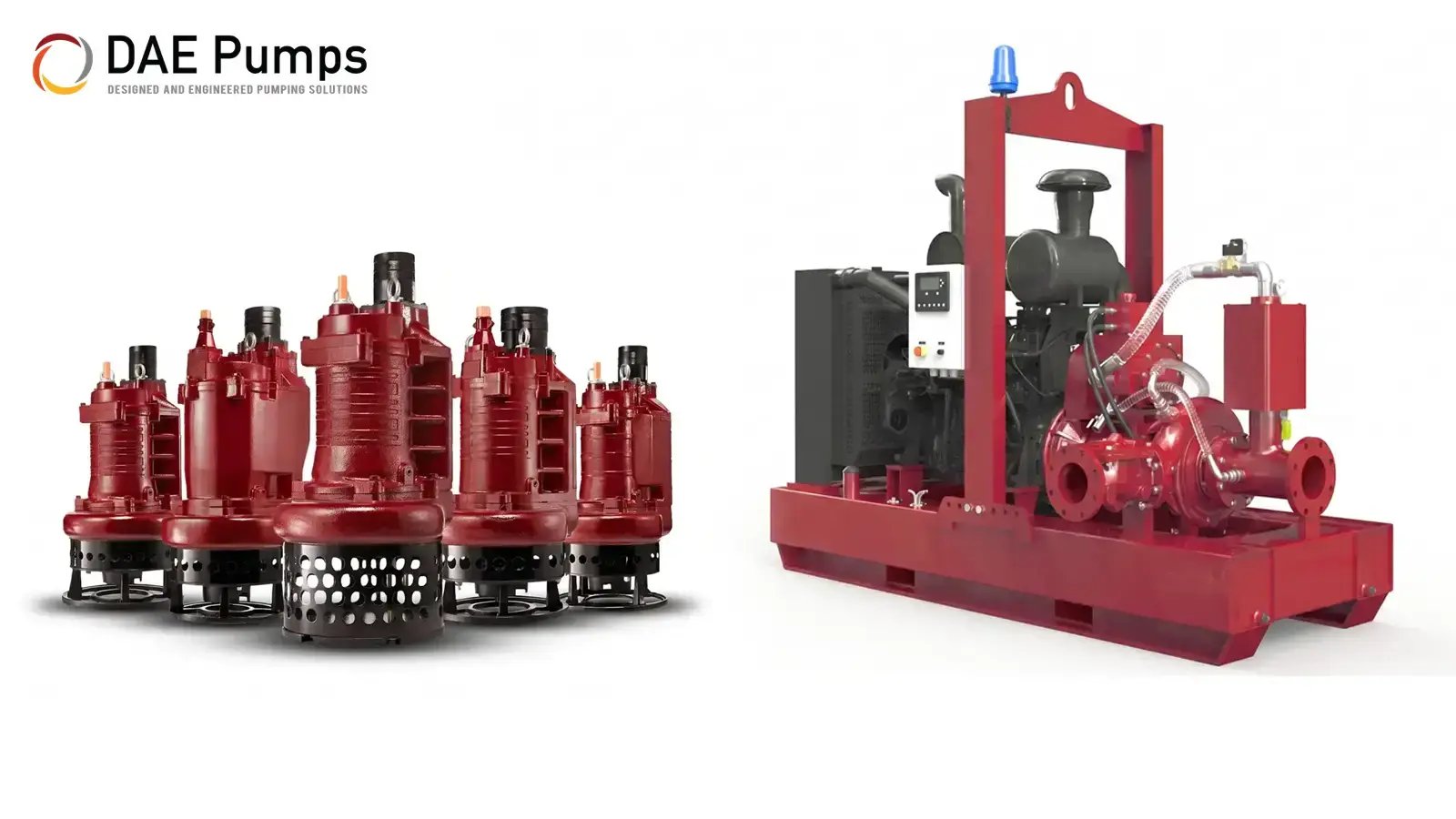
DAE Pumps does not need to force every customer into one configuration. The product path should start with the jobsite problem: where the pump can be placed, how the material behaves, how far it must move, and how crews need to service the equipment.
|
Application need |
DAE product path |
|
Surface pump, easy access, suction lift, temporary dewatering, bypass, or portable field pumping |
Self-Priming Pumps, MAX-Series, Appalachian Series, Radford Series |
|
Abrasive slurry, sand, sediment, sludge, or solids directly in a sump, pit, pond, or basin |
|
|
General drainage, sludge, slurry, or sand pumping where a submerged pump is preferred |
|
|
Gravity-fed tank, hopper, or process transfer where the pump can sit below liquid level but remain accessible |
|
|
Dredging, sediment removal, cable deployment, or pump-at-the-work-face applications |
|
|
Long discharge line or high-head pipeline support |
|
|
Unclear flow, head, material, or duty point |
Procurement and Lifecycle-Cost Check
When we compare self-priming and submersible options, we look beyond the pump price. The configuration changes the cost of suction piping, electrical or hydraulic infrastructure, lifting equipment, controls, operator attention, retrieval, and downtime. A lower-priced pump can become the expensive choice if the site cannot support its installation or maintenance method.
- Self-priming cost factors: suction hose and fittings, priming system, trailer or skid, engine or motor package, fuel or electrical connection, air-leak inspection, and practical suction-lift margin.
- Submersible cost factors: power cable or hydraulic hoses, starter or HPU, lifting system, retrieval labor, wet-side inspection access, cable protection, and spare-unit strategy for critical service.
- Operating factors: expected flow range, energy or fuel use at the actual duty point, solids settling, operator coverage, relocation frequency, and the cost of stopping the process for service.
- Risk factors: changing liquid level, flooding, suction collapse or air leaks, cable damage, low submergence, debris, confined-space exposure, and the availability of qualified service personnel.
Selection principle: choose the configuration that keeps the pump reliably supplied and realistically serviceable at the site. Use the NPSH guide when a surface installation is being considered.
What to Send DAE Before Asking for a Recommendation
The fastest way to get the right recommendation is to send the site details that determine whether self-priming, submersible, flooded suction, or another configuration fits. Before you request a quote or ask for a custom pump curve, gather the following:
- Material being pumped: water, sludge, sand, slurry, tailings, sediment, sewage, grit, or mixed solids.
- Solids information: particle size, abrasiveness, percent solids, specific gravity, and whether material settles quickly.
- Pump placement: above the liquid, in the liquid, below tank level, on a trailer, on a skid, or on a dredging platform.
- Suction conditions: suction lift, hose diameter, hose length, fittings, foot valve/check valve, and water-level fluctuation.
- Required flow and head: target GPM, vertical lift, discharge distance, pipe or hose diameter, and discharge location.
- Power source: electric, diesel, hydraulic power unit, available voltage, or jobsite generator.
- Maintenance constraints: lifting access, service frequency, downtime limits, and whether the pump must move between locations.
Frequently Asked Questions
What is the main difference between a self-priming pump and a submersible pump?
A self-priming pump sits above the liquid and pulls material up through a suction line after evacuating air. A submersible pump sits in the liquid, so the inlet is already flooded and the pump does not need a priming cycle.
Is a submersible pump always better for slurry?
No. A submersible slurry pump is often better when the pump can sit directly in the material, especially in pits, sumps, ponds, basins, or dredging areas. A self-priming pump may be better when crews need above-ground maintenance access or a portable surface-mounted package.
When should I choose a self-priming pump?
Choose a self-priming pump when the pump needs to stay above the liquid, the job moves between locations, the pump must be easy to service from the surface, or the application requires a skid or trailer-mounted pump package.
When should I choose a submersible slurry pump?
Choose a submersible slurry pump when the pump can be lowered directly into the sump, pit, pond, or basin and the job involves abrasive slurry, sand, sediment, sludge, or settled solids at the source.
Does submersible mean no priming issues?
In practical terms, yes. A submersible pump operates while submerged, so it is already flooded and does not need to pull fluid up through a suction lift line. The system still needs correct discharge sizing, power, controls, and solids handling review.
Can the same project use both pump types?
Yes. Many dredging, mining, construction, and wastewater projects use different pump configurations in different parts of the same system. For example, a submersible pump may work at the solids source while a self-priming pump supports bypass, transfer, or dewatering elsewhere.
Which pump is easier to maintain?
A self-priming pump is usually easier to access because it remains above the liquid. However, a submersible pump may still be the better overall choice if it reduces priming issues, suction lift problems, and jobsite complexity.
What if neither option seems right?
If the pump can be gravity-fed from a tank or hopper, a flooded suction pump may be a better fit. If the discharge distance is long, a booster pump may be needed. If the project is dredging-specific, a cable-deployed or other dredge pump configuration may be better.